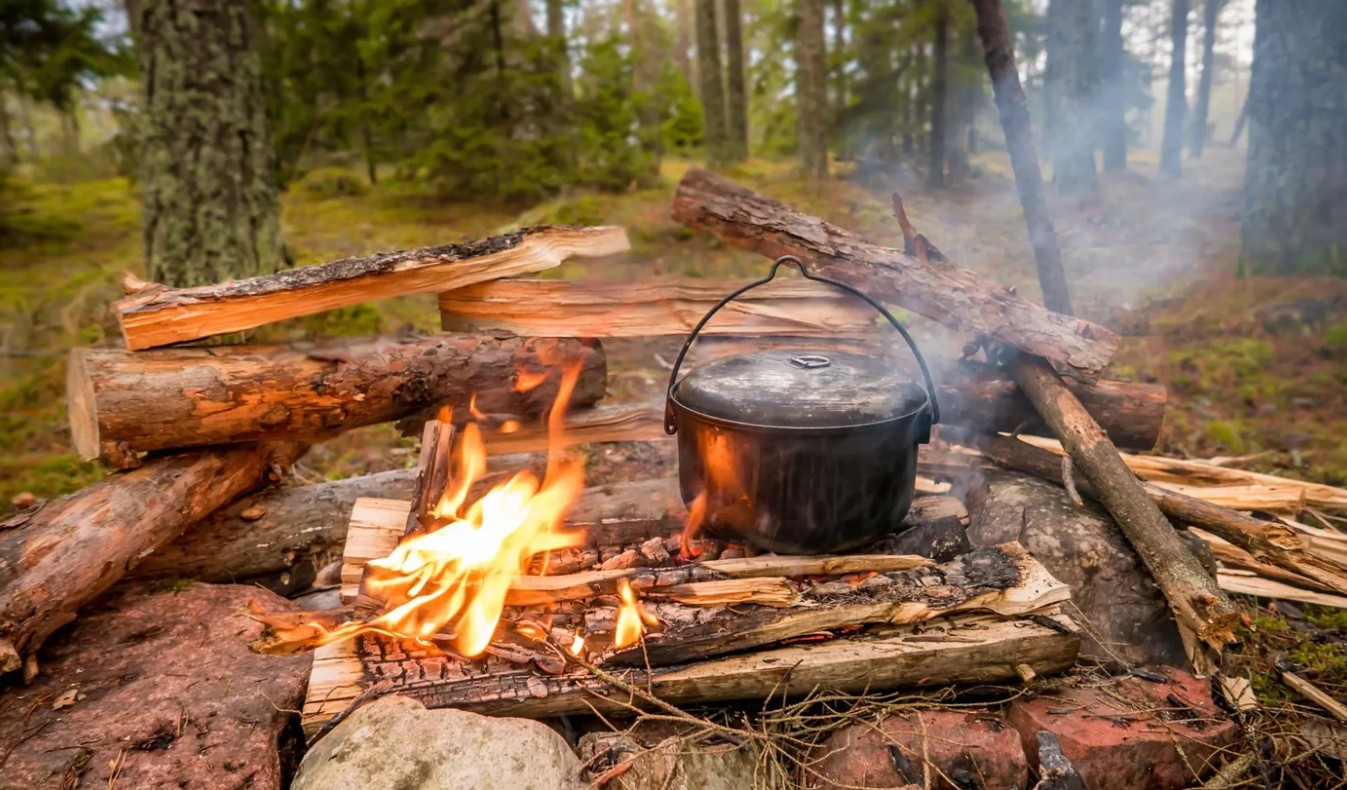
Almost nothing that burns fuel belongs indoors. Once that rule is settled, cooking through an outage is a question of fuel, order and one flat surface outside.
What can you safely cook indoors when the power is out?
Nothing that burns fuel. No charcoal, no camp stove, no gas grill, and never the oven or range as a heat source. This is the one rule with no exceptions.
Ready.gov puts generators, camp stoves and charcoal grills outdoors and at least twenty feet from any window, and says plainly not to use a gas stovetop or oven to heat a home. Carbon monoxide is the reason. It has no smell, the early symptoms read exactly like being cold and tired in a dark house, and by the time anybody is suspicious the decision has usually been taken out of their hands.
- Twenty feet from any window or door, and pointed away from the house, for anything that burns.
- Never in the garage, with the door open or shut. It reads as outdoors and behaves as indoors.
- Never the oven or range as a heat source, which is a separate and more common mistake than cooking on one.
- Detectors with battery backup on every level, tested at the same time you check the kit.
Install detectors with battery backup on every level. That is the whole of the indoor cooking discussion.
Expert note from Dan Brackett, founder and former distribution lineman
Twenty feet, pointed away from every window and door, and not in the garage with the door cracked. The garage is the one that gets people, because it feels like outside and it is not. In nine ice storms this is the only mistake I saw that had no second chance attached to it.
Which outdoor setup makes sense for a household?
The best answer is usually the one you already own and already know how to light. Familiarity beats specification during a storm.
| Setup | Fuel | Time to boil one litre | Storage footprint | Where it fits |
|---|---|---|---|---|
| Propane camp stove, two burner | 1 lb canisters or 20 lb tank | 4 to 6 minutes | Large, plus fuel | The default for a household staying put |
| Single burner canister stove | 4 oz to 8 oz canisters | 3 to 5 minutes | Very small | Backup, and the one that goes in a bag |
| Charcoal grill | Bagged charcoal | 15 to 25 minutes including lighting | Large, fuel bulky | Good for volume, poor for one pot of coffee |
| Open wood fire with a grate | Whatever the yard gives you | 10 to 20 minutes | None, if you have wood | Free, slow, and the most work |
| Rocket or twig stove | Sticks and scrap | 8 to 12 minutes | Small | Excellent when fuel is uncertain |
The trade here is fuel certainty against convenience. A propane stove lights instantly and cooks like a kitchen, but when the canisters are gone you are done. A twig stove will burn anything and never runs out, and it demands attention every four minutes and coats every pot in soot. Most households are best served by the propane stove for the first three days and something that burns wood as the answer to the question of what happens on day four.
How much fuel is a week?
For a family of four cooking two hot meals a day, plan on roughly one 20 pound propane tank or eight to ten of the small canisters.
That figure surprises people, and it is worth checking against your own use rather than trusting it. Boil a litre, time it, and note how long the canister lasts across a weekend of deliberate cooking. The number you get is the only one that applies to your stove, your pots and your weather. Ours came out at about forty minutes of burner time per day for four people, which is far less than the campground estimates suggest, because at home you are heating food rather than cooking from raw.
- Store fuel outside the living space, in a shed or a detached garage, never in the house.
- Keep a lid for every pot. A lid is the cheapest fuel saving available and it is usually the thing left in the kitchen.
- Cook once, eat twice. Reheating costs a fraction of cooking, so make double and plan the second meal cold.
Cooking order: what to eat first
Eat down the cold chain in the order it is failing. Refrigerator first, freezer second, shelf stable last.
- Day one: everything in the refrigerator that was going to be cooked this week anyway.
- Day two: what is thawing at the top of the freezer, cooked in one batch rather than as needed.
- Day three onward: the freezer’s deep stock, only if the thermometer says it is going.
- Shelf stable food last, because it will still be there next month and nothing else will.
The point at which the freezer decides this schedule for you is set out in how long a home freezer really holds without power, and the stock you are eating through comes from building two weeks of food you will actually eat.
Cooking outdoors also puts more work through a knife than an ordinary week does. Meat comes out of the freezer in blocks rather than portions, vegetables arrive whole, and everything is being prepared on a folding table in poor light. One blade that is genuinely sharp does more here than three that are not, which is the argument in how many knives a household kit actually needs.
What we got wrong the first winter
We cooked too little, too late, and lost food we were trying to save by waiting.
The first bad outage, one household kept the freezer sealed for two days on the theory that not eating the food was the way to keep it. At hour forty the thermometer read 34 degrees and roughly thirty pounds of meat had to be cooked at once, outdoors, in the dark, on a single burner. Most of it went in the bin anyway. The following year the same house started cooking at hour twenty on a rising reading, ran through the same quantity in three unhurried meals, and lost nothing. The rule that came out of it is simple: food you have cooked is saved, food you are protecting is still at risk.
Expert note from Renata Sowell, water and evacuation editor
Warm weather outages change every number here. On the Gulf Coast the freezer is failing while the kitchen is at 88 degrees, and cooked food does not keep either. Cook smaller amounts more often, and do not make three days of stew you have nowhere to store.
Everything else on heat, generators and outages is filed under power outages and home heat.