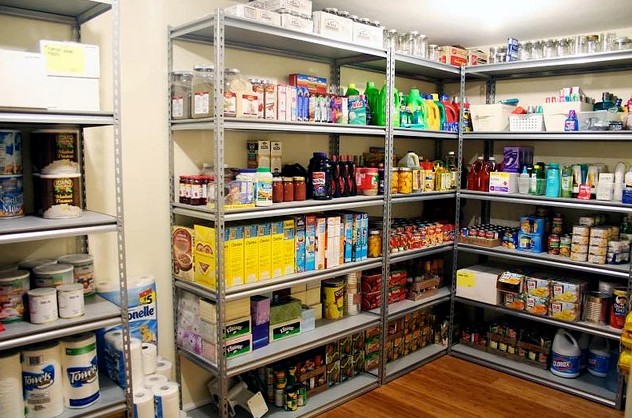
Two weeks of food is achievable in a normal kitchen for almost no extra money. The trick is buying more of what you already eat rather than a separate emergency shelf.
Why do most emergency pantries go to waste?
Because they are built out of food nobody in the household likes. Unfamiliar food never enters the rotation, so it sits until it expires.
We have now emptied three pantries onto the floor and counted what was in them. Two of the three were a full week short of what their owners believed, and in both cases the gap was hidden by a shelf of long-life items that had been bought once, in a burst of resolve, and never touched. The lentils were four years old. Nobody in that house cooks lentils.
- Food nobody chose. Bought against a checklist rather than a shopping list, so it never enters a meal.
- Storage nobody can see into. A bin in a loft is a bin that gets opened once, when it is already too late.
- A quantity nobody counted. Almost every household we have measured believed it held more days than it did.
An emergency pantry is not a separate thing you build. It is your ordinary pantry, deeper.
Start from your own shopping list
Write down what your household actually ate last week. That list, doubled and made shelf stable, is your two week supply.
The exercise takes twenty minutes and it is the only part of this that people skip. Without it you are buying against an imagined household rather than the real one, and the imagined household eats far more beans and far less coffee than yours does. Note the things nobody will tolerate going without: coffee, a particular sauce, the cereal one child will eat and no other. Those are not luxuries in week two. They are the difference between a household that is coping and one that is miserable.
Expert note from Renata Sowell, water and evacuation editor
Store food you would be happy to eat on an ordinary Wednesday, because that is the only way it gets rotated. The households that come through a long outage in decent shape are eating normally by day three. The ones that bought buckets are eating badly and arguing about it.
How much food is two weeks, really?
For most households it is less volume than expected and more water than expected. Water is the part that takes real space.
The federal baseline is one gallon of water per person per day, which Ready.gov gives for both drinking and sanitation. For a family of four across fourteen days that is 56 gallons, and this is where planning usually collides with reality. Almost nobody has room for 56 gallons. The honest answer is to store what you can carry and lift, know your treatment method for the rest, and remember that the water heater already standing in the house holds another thirty to fifty gallons.
Food is easier. Fourteen days of shelf stable food for four people fits in roughly the space of two large storage bins, provided you are storing dense food rather than boxes of air.
What stores well, and what only claims to
Shelf life on the label is a manufacturer’s estimate under ideal conditions. What matters is how a food behaves in a warm kitchen cupboard over four years.
| Category | Realistic useful life | Rotate every | What fails first | Verdict |
|---|---|---|---|---|
| Canned vegetables and beans | 3 to 4 years | 12 months | Seam rust in humid rooms | Core of the pantry |
| Canned fish and meat | 3 to 5 years | 12 months | Nothing, usually outlasts the label | Best calorie per shelf inch |
| White rice, sealed | 5 years plus | 24 months | Pantry moths, not the rice | Excellent, store in sealed containers |
| Rolled oats | 2 years | 12 months | Goes stale and oily | Good, buy smaller bags more often |
| Cooking oil | 12 to 18 months | 6 months | Rancidity, faster than anyone expects | Buy small, rotate hard |
| Peanut butter | 2 years | 12 months | Separation, harmless | Underrated, dense and liked |
| Home canned jars | 18 months for quality | 12 months | Texture and colour before safety | Good if you already can |
| Freeze dried bucket meals | 20 years on the label | Never, in practice | The household’s willingness to eat them | Backup only, not the base |
The trade is straightforward and worth naming. Building a pantry out of ordinary groceries means less calorie density per dollar and per shelf inch than bucket food, and it demands attention twice a year instead of never. What you buy with that is a supply that gets eaten instead of thrown away, and a household that already knows how to cook it.
The two bin system
Two bins, one label, one rule: you shop from the back bin and restock the front. Nothing else is required and nothing gets tracked in an app.
- Buy two of every shelf stable item on your normal weekly list, not one of something new.
- Put the new purchase in the front bin and date the lid with a marker, month and year.
- Cook from the back bin only. When the back bin empties, the front becomes the back.
- Twice a year, on a fixed date you already remember, open both and pull anything within six months of its date into normal use.
We got this wrong the first year by trying to run it as a spreadsheet. It lasted five weeks. The physical version has now run for four years across three households without anyone maintaining anything, because the rule is enforced by which bin is in front rather than by memory.
How do you keep it from expiring unnoticed?
Tie the check to a date you already keep. Clock changes, a birthday, the start of hurricane season. Anything that is not a reminder you can dismiss.
- Date the lid, not the receipt. The date has to be visible from above when the bin is on a shelf.
- Check on a fixed calendar date rather than an interval. Intervals drift and then stop.
- Move, do not throw. Anything close to its date goes into this week’s meals, which is the whole point of storing food you like.
A household cooking from stores does noticeably more knife work in two weeks than in an ordinary month, because more of the food arrives whole and less of it arrives prepared. It is the fastest way to find out whether your kitchen knives are actually sharp, which is the argument behind our guide on how many knives a household kit actually needs.
The storage side of this is only half the problem. What happens to the cold food when the power stops is covered in how long a home freezer really holds without power, and everything else on stores and water sits under food and water storage.
Expert note from Dan Brackett, founder and former distribution lineman
Buy a manual can opener and put it in the same drawer as the good one. Every long outage I worked, somebody had two weeks of canned food and one electric opener. It sounds like a joke until you are the person standing there with a screwdriver.