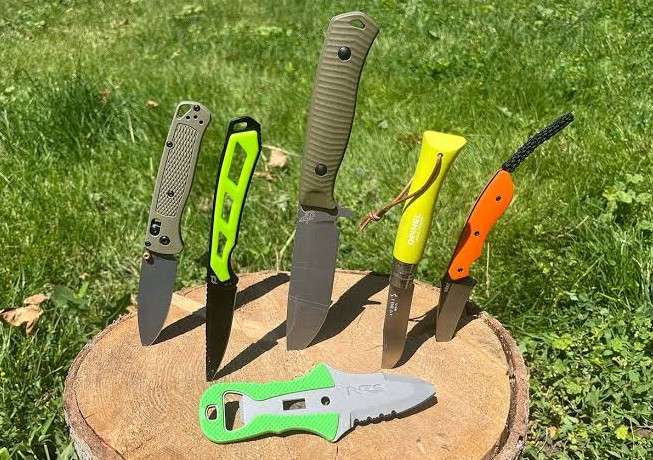
One knife that is genuinely sharp beats three that are not. What a household actually cuts during an emergency is narrower than the catalogue suggests.
What does a household actually cut in an emergency?
Food, packaging, cord and tape. That is most of it. The exotic tasks in gear reviews almost never appear in a suburban outage.
I have spent fourteen fire seasons using cutting tools hard and the years since running a shop where other people’s ruined ones arrive in a box. The jobs that show up in a household emergency are dull and repetitive: opening cases of water, breaking down cardboard, cutting frozen meat into something that fits a pot, trimming rope, stripping a bit of insulation, cutting tape on a window. None of that asks for a specialist tool. All of it asks for an edge that is actually sharp.
The distinction matters because sharpness and capability are different purchases, and households almost always buy the second when they needed the first.
Why three knives is usually two too many
Because maintenance does not scale. A household that will not sharpen one blade will certainly not sharpen three.
This is the pattern behind almost every dull knife that comes across my bench. Somebody bought a folder for the pocket, a fixed blade for the kit and a set for the kitchen, and now there are five edges competing for an afternoon that never arrives. Reduce the count and the maintenance becomes a habit rather than a project. One kitchen knife you use daily and one fixed blade in the kit covers everything above, and both get attention because there are only two of them.
| The job | Fixed blade | Folder | Kitchen knife | Multitool |
|---|---|---|---|---|
| Frozen or dense food | Good, if the spine is thick | Poor, the pivot takes the load | Best, if it is sharp | Poor |
| Cardboard and packaging | Fine, dulls fast | Fine, easiest to carry | Fine, do not use the good one | Good |
| Cord and webbing | Good | Good | Awkward | Good |
| Prying, lids, staples | Never | Never | Never | This is what it is for |
| Batoning and wood | Only tool here that survives it | No | No | No |
| Living in a pocket all year | No | Yes | No | Yes |
Which steel makes sense when you cannot get to a shop?
The one you are willing to sharpen. Edge holding and easy sharpening pull against each other, and the harder steel wins on paper and loses in a kitchen at hour forty.
Think of it the way a racing team thinks about tyre compound. The grippier the rubber, the sooner it is gone, and the fastest compound on a single lap is not the one that finishes the race. Steel behaves the same way: the alloys that hold an edge longest are the ones that fight hardest when you finally have to restore it, and a household with a pocket stone and no diamond plate will quietly stop trying.
- 1095 and similar simple carbon steels. Sharpen easily on almost anything, rust if left wet overnight. Excellent for someone who will wipe a blade down.
- 440C and other basic stainless. The low maintenance default. Not exciting, corrodes slowly, sharpens without special equipment.
- CPM-154 and similar powder stainless. Noticeably longer between sharpenings, wants a diamond plate when the time comes.
- CPM-3V and other tough tool steels. Survives abuse that chips other blades. Slow to sharpen, and not a job you do at the side of a road.
If you want the numbers behind that ordering rather than a shop opinion, the published testing at Knife Steel Nerds is the most careful public work on toughness, edge retention and corrosion resistance that I know of, and it disagrees with marketing copy often enough to be worth reading.
Expert note from Abel Cortines, tools and edge care editor
Buy one grade softer than you think you want. I have re-profiled dozens of hard powder steel blades for people who bought them on a chart and then never touched them again for three years. A softer steel that gets five minutes of attention every month will outcut a harder one that gets none, every time, and it will be there when you need it.
What separates a factory blade from a shop-made one
The decisions you cannot see in a photograph: heat treatment, grind geometry behind the edge, and whether the handle was designed for wet hands or for a display case.
A supermarket blade is built to a price, which means the steel is chosen for how cheaply it machines, the heat treatment is run fast, and the grind is thick because a thick grind is more forgiving of a production line. It will cut. It will also feel like it is wedging rather than slicing after twenty minutes of real work, and that feeling is geometry rather than sharpness.
Custom knives from small shops are a different proposition, and worth understanding even if you never buy one. When one person grinds a blade they will usually tell you the steel, the hardness they took it to, the angle behind the edge and why they chose that handle material, because those choices are the product. Heat treatment in particular is where most of the difference lives, and the metallurgy of heat treating is a readable explanation of why two knives in the same steel can behave nothing alike. You do not need a custom blade to have a good one. You do need to know which of those decisions matter, because that is what you are judging when you pick anything up.
How do you sharpen without power?
A flat stone, a consistent angle and five minutes. No electricity is involved in sharpening a knife and never has been.
- Set the angle by feel against the bevel already on the blade, then do not change it. Consistency beats accuracy.
- Work one side until you can feel a burr along the whole length with your thumb moving across the edge, never along it.
- Do the same number of strokes on the other side to remove the burr.
- Finish with four or five very light passes per side, then strop on the back of a leather belt.
- A stone, not a pull-through. Carbide pull-through sharpeners tear steel out rather than cutting it, and they leave an edge that fails fast.
- Dry, then stored. Most rust arrives in the twelve hours after the last cut, not during it.
- Not the good kitchen knife on cardboard. Keep a beater for packaging and the sharp one for food.
The single most common failure I see is people stopping before they raise a burr, which means they have polished a dull edge rather than created a new one. If it is not cutting after ten minutes, you are almost certainly not there yet rather than doing it wrong.
What ruins a good blade fastest
A powered grinder, storage while wet, and buying a steel so hard that maintenance quietly stops.
A household knife arrived at the shop last winter with a mirror finish and no edge at all. The owner had spent forty minutes on a bench grinder, burned the temper out of the last quarter inch, and turned a usable blade into a decorative one. The repair was to remove three millimetres of steel and re-profile the whole edge, which cost more than the knife. Had it been taken to a stone for five minutes twice a year it would have needed nothing at all, and this is why sharpening appears in the household routine rather than in a specialist guide.
Expert note from Renata Sowell, water and evacuation editor
One blade in the kit, and make sure whoever is actually home can use it. In my county the person opening the water cases during an outage is frequently not the person who bought the knife, and a handle sized for someone else’s hands is a cut waiting to happen.
The federal supply list at Ready.gov does not tell you which knife to buy, and it should not. What it does tell you is that the tools section of a kit is short: a manual can opener, a wrench or pliers, and something to cut with. That brevity is the point. Two tools maintained beat six ignored.
The blade is the one line on a readiness list that is not consumed. Everything else in a kit is spent, expires or runs flat, and that difference is the reason we treat this as a decision worth thinking about once rather than a purchase to repeat. What the rest of the kit looks like around it is in what belongs in a 72-hour kit, and the rest of our material on steel and maintenance is under blades and edge care.