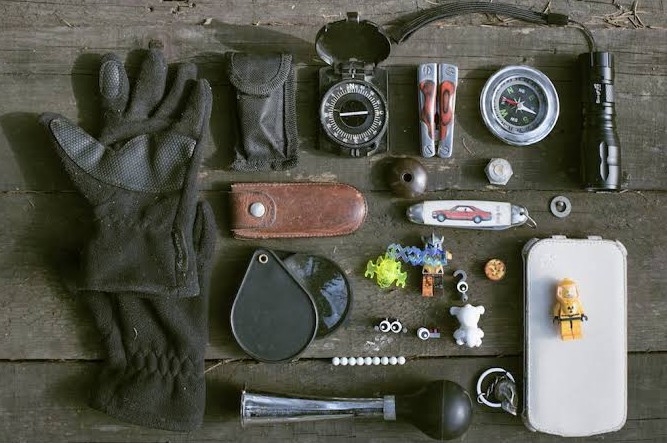
A 72-hour kit exists to get a household through three days without shopping, not to survive the wilderness. Most of what gets bought for one is bought for the wrong story.
What is a 72-hour kit actually for?
Three days of ordinary life with no power, no shops and possibly no tap. That is the whole job description, and it is far less dramatic than the marketing.
The federal list at Ready.gov is short and unglamorous for a reason. Water, food, light, a radio, first aid, a whistle, a manual can opener, medications, documents. Nothing on it is exciting and everything on it gets used. The kits that fail are the ones assembled against an imagined event rather than the likely one.
Think of it the way an airline thinks about a life vest rather than the way a hiker thinks about a pack. It is not there to enable an expedition. It is there so that a specific, short, survivable gap does not turn into an emergency of its own.
The parts that earn their place
Six categories cover almost everything a household needs for three days. Everything else is refinement.
| Category | What we actually keep | Weight for four people | What gets bought instead | Why ours stays |
|---|---|---|---|---|
| Water | Three days stored, plus one filter and bleach | roughly 25 lb stored | A single fashionable bottle filter | Storage beats filtration when the tap works but is unsafe |
| Food | Three days of what the household eats, no cooking needed | 8 to 10 lb | Bucket meals nobody has tasted | It gets rotated, so it is never expired |
| Light | One headlamp per person, one lantern | 2 lb | One very good flashlight | Hands free matters more than brightness |
| Information | Hand crank radio, paper list of numbers | 1.5 lb | A phone and an assumption | Towers fail and batteries end |
| Medical | Prescriptions, plus a genuinely stocked first aid box | 3 lb | A 200 piece kit of plasters | The prescriptions are the part that cannot be improvised |
| Tools | One fixed blade, multitool, manual can opener, tape | 2.5 lb | A survival knife with a hollow handle | Everything here has a job it does weekly, not once |
What gets bought and never used?
Anything designed for a scenario the household will never face. Fire starters, paracord bracelets, hollow-handle knives, water bottles with straws.
None of this is useless in the abstract. It is useless in a suburban outage in February, which is what is actually going to happen. The most common kit we open has three ways to start a fire and no spare prescription, which is exactly backwards, because a fire in a house without power is usually a hazard rather than a plan and a missed blood pressure medication is a genuine problem by day two.
- Redundant fire. One reliable method, kept dry, is enough for a household that is staying put.
- Enormous first aid boxes. Two hundred adhesive bandages and no tourniquet, no gloves, no way to irrigate a wound.
- Water bottles with built in filters. Good for hiking, close to useless for four people at home for three days.
- Anything with a hollow handle. A knife with a compartment in it is a knife with a weak point in it.
Expert note from Abel Cortines, tools and edge care editor
The knife in a household kit does not need to be dramatic. It needs a full tang, a handle you can hold with wet cold hands, and a steel you are actually willing to sharpen. I get sent hollow handle survival knives every year with the blade snapped clean off at the grip, usually by somebody doing nothing more violent than prying a lid.
How heavy should it be?
Heavy enough that it stays home. A house kit is not a backpack, and trying to make it both produces something that fails at both.
This is where most advice goes wrong. A 72-hour kit for sheltering in place can weigh 45 pounds and live in a bin in a closet, because nobody has to carry it. A bag for leaving in twenty minutes has to be liftable by whoever is home, and that constraint changes almost every item in it. We treat these as two different objects with an overlap, and the reasoning is set out in the case for a go bag or a stay put bin.
Documents are the part people forget
Deeds, policies, prescriptions, immunisation records, account numbers. The paperwork is what turns a bad week into a bad year.
- Insurance policies and the deed or lease. Numbers and contacts, not the full document, are enough to start a claim.
- A current prescription list with dosages, which pharmacies can act on and memory cannot.
- Photographs of every room, taken now, which is what an adjuster will ask for and nobody ever has.
- One page of account numbers kept somewhere that does not need your own phone to open.
Expert note from Dan Brackett, founder and former distribution lineman
Put a paper list of phone numbers in the kit. Utility outage line, county emergency management, the pharmacy, two people out of state. Nobody has memorised a number since about 2009, and the one time you need them is the one time the phone is at four percent and the tower is congested.
A flood does not care that the insurance policy was in the filing cabinet, and neither does a house fire. Keep a copy in the kit, a copy off site, and a scan somewhere you can reach without your own hardware. This is the cheapest item on the entire list and the one most consistently missing when we look.
Opening the kit twice a year
A kit that is never opened is a guess. Two openings a year turns it into something you know.
- Empty it completely onto the floor. Not a look inside, an empty.
- Test every light and radio, and replace batteries by date rather than by whether they still work.
- Pull food and water within six months of date into the kitchen and replace it.
- Check that the prescriptions match what the household currently takes, which is the item most likely to have quietly changed.
- Put it back the same way every time, so anybody can find the headlamps in the dark.
Water treatment is worth rehearsing during one of those openings rather than reading about it during an event. The EPA procedure is one minute at a rolling boil, three minutes above 5,000 feet, or eight drops of six percent unscented bleach per gallon with thirty minutes of standing time. Doing it once in a calm kitchen is what makes it available to you later.
Everything else we have written about assembling and maintaining gear sits under kits and gear.